


Residential -
How to sell a home that's one of a kind
So how best to market something that’s a little out of the ordinary?
For most homes, buyers arrive with a familiar mental checklist. Location, bedrooms, bathrooms, garaging, outdoor space and perhaps the school zone can quickly establish whether a property warrants a closer look.
But what happens when a property can’t be neatly summed up by conventional measures?
For truly unique homes, it may be the architecture, history, setting, scale or lifestyle that carries the greatest weight. But according to three Bayleys salespeople currently marketing three very different standout properties, identifying that point of difference is only the beginning.
The real skill lies in translating it into a campaign that makes the right buyers stop, look and ultimately understand why the property is special.
Sell the experience, not just the specifications
In the Puketui Valley near Tairua, Earthship Te Timatanga is a four-bedroom home sitting on 1.08 hectares and built according to Earthship principles.
Natural and recycled materials, passive solar design, clay brick and bottle walls, water and energy systems, and an indoor growing atrium combine to make the home a living system rather than a residence.
For Bayleys Tairua salespeople Heather Sturgeon and Sandie Faiers, that means a traditional property marketing formula would fail to capture what buyers are actually being offered.
“There are numerous standout features; one is the property’s organic architecture and tranquil setting working in perfect harmony.”
“Every moment spent at Earthship Te Timatanga in the Puketui Valley leaves you feeling healthier, calmer, and happier. That means the campaign is about selling the feeling and experience of the property, not simply listing its features.”
It’s a useful distinction for owners preparing to sell a home with an unusual feature. Rather than automatically leading with its most unconventional element, sellers should first consider how that feature changes the experience of living there.
Heather and Sandie say some characteristics are also best revealed gradually.
“We make it part of the hero story, while still keeping the property front and centre.”
That balance helps generate enough intrigue to prompt an inspection, where characteristics that are difficult to articulate in words or images can be experienced properly.
“The response from prospective purchasers who have viewed the Earthship to date has been that it’s even more magical and amazing than anticipated.”
Find the right way to tell the story
Photography remains fundamental to residential real estate, but unique homes can demand more than a standard sequence of wide-angle room shots.
At Ohui, an expansive coastal property near Opoutere, Bayleys Whangamatā salesperson Dale Sholson quickly realised still images alone wouldn’t do the property justice.
Spread across 30.88 hectares, Ohui includes a substantial six-bedroom residence, pool, separate recording studio and accommodation, expansive coastal views and access towards an isolated white-sand beach. The land also previously hosted festivals and wellness retreats, giving it a history and identity extending well beyond that of a conventional coastal home.
“This whole property has so many hero aspects it was difficult to determine what to focus on.”
“Walking down the internal stairs on my first visit to the property, I knew images would only tell 20% of the story, so a comprehensive video was to be the primary promotional tool.”
Rather than trying to reveal everything at once, the campaign used video to showcase its scale and features while retaining enough “mystique” to encourage potential buyers to experience it themselves.
Sholson says it highlights an important consideration for vendors: the strongest marketing format should be dictated by the property.
For an intricate architectural home, that could mean detailed photography and editorial-style imagery. A property defined by movement between spaces may benefit more from video. For significant landholdings, drone footage can establish scale and context in a way traditional photography cannot.
Sholson says Ohui warranted a particularly comprehensive approach, including international exposure to reach New Zealand expats and a significant investment in marketing from the vendors.
While promoting long-form video rather than a short reel carried some risk, he says the decision paid off, with strong initial exposure creating a snowball effect as suppliers and other networks continued sharing the campaign.
Let architecture take centre stage
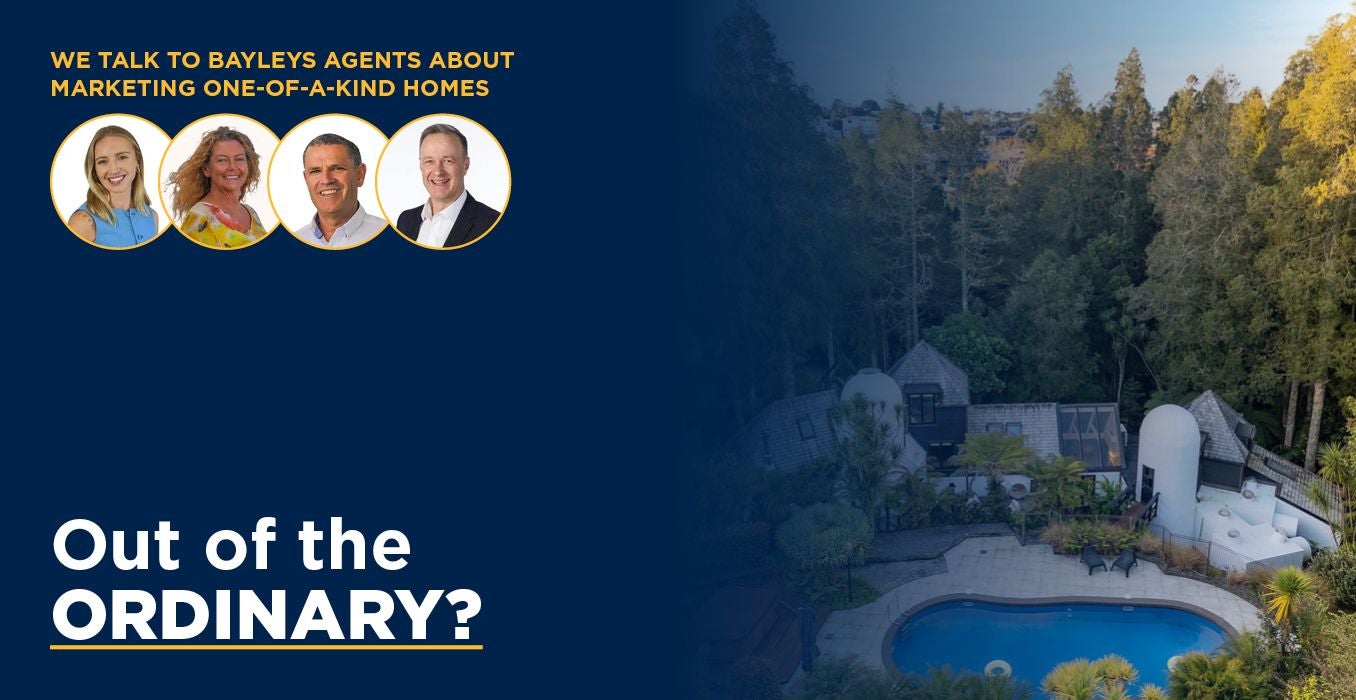
For some properties, however, there’s no question about what belongs at the centre of the campaign. The Cole House at 24 Channel View Road in Auckland’s Campbells Bay is a landmark residence designed by the late Sir Ian Athfield.
Originally commissioned for the Cole family in 1975, the home carries unmistakable elements of Athfield’s work, including sculptural forms, bottle towers, porthole windows, dramatic ceiling heights and cedar and concrete construction.
Bayleys Takapuna salesperson Darryn Hayes says that combination fundamentally changes who the campaign is designed to reach.
“Rather than targeting the traditional four-bedroom family home buyer, we are focused on attracting a more specific audience, including architectural enthusiasts, lifestyle buyers, creatives, and those seeking a private retreat without sacrificing convenience.”
“The campaign is less about bedrooms and floor area, and more about the experience, character, and uniqueness of the property.”
Hayes opted for a more magazine-style photographic treatment, highlighting architectural details and the changing interaction between light and the home. Dusk photography and video were also used to create atmosphere rather than simply documenting every room.
“The objective is not simply to show every space, but to tell a story and capture the feeling of living there.”
“With homes of this nature, creating intrigue and emotional engagement is often more effective than revealing every detail upfront.”
Know who you’re talking to
A distinctive feature may generate enormous curiosity, but curiosity and buyer intent aren’t necessarily the same thing.
Unique properties can attract a more specialised buyer pool, making targeted marketing particularly important.
Hayes says purchasers looking at homes such as The Cole House may place a higher priority on “design, lifestyle, privacy and individuality” than conventional measures such as floor area.
Alongside the major property portals, the campaign has also focussed on reaching audiences interested in architecturally designed homes, premium lifestyle properties and larger landholdings.
“Editorial coverage also provided another avenue for reaching people who may not have been actively searching for a new home at all.”
Sturgeon agrees that understanding the likely buyer is crucial.
“Unique properties tend to attract buyers who are looking for something specific rather than simply comparing bedrooms and bathrooms,” she says.
“The key is understanding what makes the property special and then targeting the people who are likely to connect with that lifestyle.”
But at the same time, targeted doesn’t necessarily mean small.
Sholson says his strategy with Ohui was to cast the net as widely as possible while also using targeted technology to ensure the campaign reached high-net-worth potential buyers.
Its unusual history also created another audience again.
“The property’s links to festivals held there more than a decade ago generated considerable public and media interest, and even prompted enquiries around possible syndicate ownership.”
Does being different add value?
For vendors, one of the biggest questions is whether an unusual characteristic adds a premium or makes a property harder to sell.
The answer can be both.
Unique attributes that are desirable, authentic and difficult to reproduce can create scarcity, but by their nature, they may not appeal to every purchaser.
“Architectural pedigree, privacy, and an exceptional setting are qualities that many buyers are willing to pay a premium for,” Hayes says.
“However, properties like this can also be more challenging to sell because the buyer pool is naturally smaller. The goal is not to appeal to everyone; it is to find the buyer who genuinely connects with the property and appreciates what makes it special.”
Sturgeon takes a similar view, noting that a highly desirable feature that cannot easily be replicated can add substantial value, provided the campaign successfully communicates its benefits to the right audience.
For Sholson, unusual features are an opportunity to earn perhaps the most valuable commodity in property marketing: attention.
“An unusual feature creates interest therefore enticing more to take one second to view your promotion,” he says.
“If it is not for the passing party, no harm done, they can simply move on. If we managed to make them stop for one second, we did a great job.”
And in a crowded property market, that ability to stop a potential buyer scrolling can be powerful.
Ultimately, the common lesson across these three remarkably different properties is not to dilute what makes a home unusual in an attempt to broaden its appeal.
Instead, lean into it. Sturgeon says you shouldn’t try to make a unique property fit a conventional marketing mould.
“The best approach is to embrace what makes it different, tell the story well, and connect with buyers who genuinely appreciate what the property offers.”
Because when the property itself is one of a kind, its marketing should be too.
Contact us


