


Commercial -
Catalyst at campus edge for astute buyers
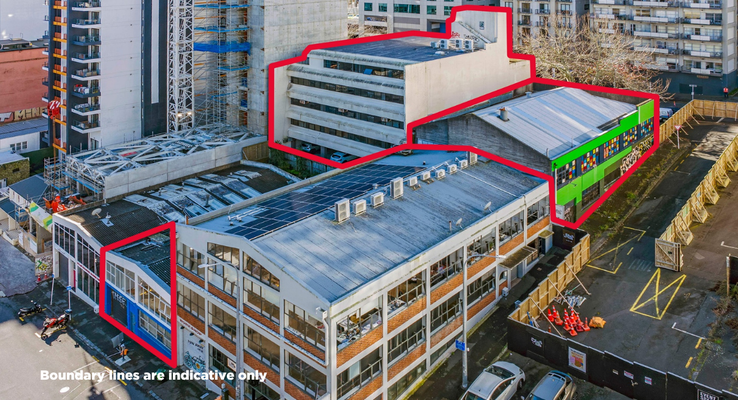
A trio of Auckland CBD properties in the city’s Learning Quarter is now for sale, giving buyers the opportunity to secure one or more strategically located assets in a precinct that remains arguably undervalued. Adjacent to the University of Auckland and AUT, the portfolio’s location underpins its long‑term relevance and provides a strong platform for future development or investment growth.
Offered individually or together, the portfolio at 65–69 Wakefield Street, 71 Wakefield Street and 40 Airedale Street totals 1,011sqm of freehold land and spans three prominent frontages across Wakefield, Lyndock and Airedale Streets. After decades of ownership and occupation, the vendor has made the decision to divest and let others pursue long-term development or repositioning opportunities.
The properties are in the Business – City Centre Zone, which is Auckland’s most development‑intensive planning framework. This zoning designation allows significant height, scale and a wide mix of commercial, residential, visitor accommodation, entertainment, and learning uses.
The largest of the three assets, 65–69 Wakefield Street, is a three-level office building with basement parking, providing 1,400sqm of existing improvements and holding income from Royal Deer and an internet café. 71 Wakefield Street is a 1930s standalone building, with dual frontage to Wakefield and Lyndock Streets giving the property strong profile. Formerly an automotive workshop and now vacant, it offers 535sqm over two levels and lends itself to a wide range of adaptive uses.
40 Airedale Street is a boutique mixed-use standalone building with 355.7sqm of residential and workshop space plus outdoor areas, offered with vacant possession. The ground level provides carparking and an office/workshop, while the upper floor contains two well-configured residential units, each with two bedrooms, a bathroom, kitchen and open-plan living.
Bayleys Capital Markets and Bayleys Auckland Metro teams are marketing the portfolio by tender, closing 4pm Thursday 10th September, unless sold prior, with Cameron Melhuish and James Were heading the campaign.
While some buyers may see value in repurposing or repositioning individual assets, given the combined footprint and its position between the University of Auckland and AUT, purpose-built student accommodation (PBSA) is likely the strongest long-term use for the site. With approximately 75,000 students enrolled across the two institutions and a persistent shortage of professionally managed student accommodation, demand for centrally located living options continues to outstrip supply.
“Globally, investors are increasingly attracted to PBSA as an evolving living-sectors asset class, supported by partnerships between universities and private operators that deliver professional management and long‑term occupancy fundamentals,” says Melhuish.
“Dedicated student accommodation plays a vital role in easing wider housing pressures and supporting the long-term vitality of university cities. Well-designed PBSA strengthens student wellbeing and connection, while also activating surrounding precincts.
“Even with more than 1,600 PBSA beds in the committed pipeline, Auckland is expected to remain materially undersupplied, reinforcing the underlying value sites with campus‑adjacent positioning such as Wakefield and Airedale Streets.”
Auckland Council’s City Centre Masterplan identifies the Learning Quarter as a key transformational area. Major projects such as UniLodge’s 758-apartment facility, Precinct Properties’ 638bed Queen Street development and its 964unit Stanley Street project are already reshaping the wider precinct, which supports the value of the subject sites for sale, says Were.
“This part of the CBD is undergoing a step-change, and the scale of committed development means the importance of these Wakefield and Airedale Street sites is heightened.
“Under Plan Change 78, well‑located CBD sites have the capacity to leverage greater intensification, as the zoning uplift gives purchasers genuine flexibility to hold, refurbish or redevelop, knowing the planning framework supports meaningful scale and a wide mix of uses.”
Contact us


